

My Trucking Authority Got Revoked – Now What?
A Step-by-Step Guide for Truckers and Carriers
Losing your trucking authority can be financially devastating. Revocation can be due to insurance lapses, compliance issues or paperwork problems. The Federal Motor Carrier Safety Administration (FMCSA) is in charge of both revoking and reinstating a motor carrier’s operating authority, so it’s important to know how to get reinstated should a revocation happen to you.
Understanding Trucking Authority
What is trucking authority?
FMCSA grants motor carriers operating authority to move freight. Having your own authority allows you to run under your own name and USDOT/MC (United States Department of Transportation/Motor Carrier) number. It also allows you to book loads directly rather through another motor carrier.
What does “revoked” mean?
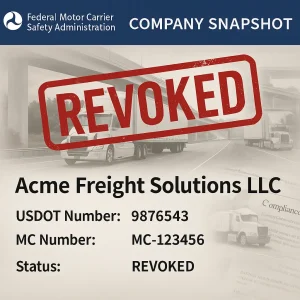
If FMCSA says your authority is “revoked,” it means you are not authorized, or not approved, to operate under your MC number. A trucking company that hauls freight while operating with revoked authority faces heavy fines, penalties or worse. Revocation is different from inactive status. Revocation means your authority has been taken away until corrective action is taken to remedy to issue.
What does “reinstated” mean?
Reinstated in this article’s context means the FMCSA has updated your operating authority status from revoked, suspended or inactive, and you are once again approved to haul loads.
Our Solution: Contingency-Based Claims Recovery
At Eckert & Associates, we focus on recovering these overlooked claims—on a contingency basis. That means:
• No upfront costs
• No risk to your fleet
• No payment unless you recover funds
We work hard to settle claims efficiently and maximize recovery, because we only succeed when you do.
Reasons That Trucking Authority Is Revoked
Revocation of a motor carrier’s authority happens for several reasons, including:
- Insurance Cancellation
- Liability insurance coverage has expired, lapsed, or was canceled. FMCSA requires proof of active insurance on file at all times. For-hire motor carriers transporting household goods (HHG) must also maintain cargo insurance.
- Improper Amount of Coverage
- Depending on the weight, freight hauled, and other factors, motor carriers must have between $750,000 and $5,000,000 in liability coverage.
- If you don’t have the minimum insurance coverage required, your authority may be revoked. https://csa.fmcsa.dot.gov/safetyplanner/MyFiles/Sections.aspx?ch=21&sec=60
- Lack of BOC-3 Filing
- Every motor carrier must have a process agent on file (Form BOC-3). If it’s invalid or missing, your authority may be revoked.
- Failure to Update MCS-150
- Carriers must update their MCS-150 form (USDOT number registration) at least every two years, otherwise, your authority can be revoked for failure to update.
- Outstanding Fees
- Unpaid fees, including Unified Carrier Registration (UCR) fees, can cause revocation. https://www.fmcsa.dot.gov/newsroom/fees-unified-carrier-registration-plan-and-agreement
- New Entrant Audit Failure
- During the first 12 months of operation, new carriers are required to pass a safety audit. Failing safety requirements can be a reason for revocation.
- Voluntary Revocation or Administrative Closure
- FMCSA can close your authority pursuant to your request or due to inactivity.
While these are the primary reasons for revocation, there are others as well. The first step to fixing your business’ revocation and reinstating your authority to operate is understanding why the authority was revoked.
Step 1: Verify the Reason for Revocation
Find out why your authority was revoked so you can take steps to solve the problem.
How to find out:
- Locate FMCSA’s Licensing & Insurance website: https://li-public.fmcsa.dot.gov/LIVIEW/pkg_menu.prc_menu:
- Enter your MC or USDOT number to view current status: The selection will either say “revoked,” “active,” or “pending.”
- Review FMCSA’s letter to you:
The reason for the revocation should be clear in the letter. - Look for the revocation date:
The revocation date will be in the letter and this is the date your authority became inactive. It will also state whether you’re within the reinstatement window.
 Step 2: Correct the Issue
 Step 2: Correct the Issue
Each reason for revocation requires different actions to move toward reinstatement.
Insurance lapse:
- Immediately contact your insurance agent and insurance company. Determine who is responsible for the lapse: 1) your agent failed to forward your payment, 2) your insurance company failed to notify FMCSA of the payment, or 3) you failed to make the payment timely.
- If your insurance agent failed to submit your insurance premium payment, ask them to submit the payment as soon as possible, as well as admit to their error in writing and pay the reinstatement fee. Insurance agents often carry Errors & Omissions “E&O” insurance, which is basically malpractice insurance to cover situations where they make a mistake.
- If your insurance company failed to notify FMCSA, ask your insurance company in writing to immediately file the proof of insurance (Form BMC-91 or BMC-91X) electronically with FMCSA. Neither you nor your insurance agent can file this form. Further, you want to obtain a letter from your insurance company admitting their mistake and paying your reinstatement fee. While they don’t often have E&O coverage, they may have a department which handles claims for errors made internally.
- If you failed to make the required payment timely, make the payment to reinstate your liability policy, or purchase a new liability policy.
Missing the BOC-3:
- Hire a BOC-3 (Bureau of Compliance) filing service or process agent within the state being represented willing to accept service of process as needed.
- File the BOC-3 form online through FMCSA’s system. Form: https://www.fmcsa.dot.gov/sites/fmcsa.dot.gov/files/2025-08/BOC-3%20Form.pdf instructions: https://www.fmcsa.dot.gov/registration/form-boc-3-designation-agents-service-process
MCS-150 update issue:
- MCS-150 form is used to update your USDOT information every two years. Form: https://www.fmcsa.dot.gov/sites/fmcsa.dot.gov/files/2025-07/MCS-150%20Form.pdf Instructions: https://www.fmcsa.dot.gov/registration/form-mcs-150-and-instructions-motor-carrier-identification-report
- Go to the portal and update it after entering your special PIN, even if nothing has changed.
Unpaid UCR fees:
- Go to the official UCR registration site: https://plan.ucr.gov/ and pay any outstanding fees.
Failed a safety audit:
- Review and correct the FMCSA safety audit violations. These violations may include: failure to comply with drug/alcohol testing, maintenance of logs, and missing driver qualification files, as well as others.
- Submit documented proof of the corrective action to FMCSA for their review.
Step 3: File for Reinstatement
After correcting any problems, request FMCSA to reinstate your authority. https://www.fmcsa.dot.gov/faq/how-do-i-reinstate-my-operating-authority-mcffmx-number
Here is the general process:
- File Form MCSA-5889 (Reinstatement of Authority):
- The FMCSA portal has this form: https://www.fmcsa.dot.gov/sites/fmcsa.dot.gov/files/2024-07/MCSA-5889%20Form.pdf and instructions: https://www.fmcsa.dot.gov/registration/form-mcsa-5889-motor-carrier-records-change-form
- Pay the reinstatement fee:
- The fee is $80, as of this writing.
- Wait for processing:
- If all documents and insurance filings are in place, reinstatement may occur within a week, but can be longer, especially if waiting on paper documents.
- Check your status regularly:
- Use the FMCSA Licensing & Insurance website to verify reinstatement has occurred.
Step 4: Pursue Damages
If your authority was revoked due to your insurance company or insurance agent’s failure to submit proper insurance documents or payments, you may have the right to reimbursement for your lost income during and after the revocation period.
- Notify at-fault party: Let them know you’ve lost revenue and/or customers because of their actions/inactions.
- Request they pay for reinstatement: By them paying the reinstatement fee, it shows some level of liability, even if they don’t admit it in writing.
- Keep records of all loads and clients lost: If you look like a brand new carrier, some brokers and shippers will not do business with you. Some may have rules that you must have active authority for 6 months or longer. Others may hesitate to work with carriers who have had revocations in the past. Be sure to get as many rejections as possible in writing to prove you’ve lost business opportunities.
Real-Life Example
Imagine this scenario:
Marty, a small fleet owner from Missouri, was told by a broker they couldn’t give him a load because his authority was revoked. Marty had paid his premium on time, but his insurance provider failed to notify FMCSA of this fact. FMCSA’s site had marked his status as “Revoked.”
Here’s how Marty fixed it:
- He called his insurance agent and confirmed his payment had been made on time.
- He called his insurance company who researched the issue.
- His insurance company sent him a letter stating that Marty had paid the premium on time but they had failed to update FMCSA.
- The insurance company electronically filed the BMC-91 with FMCSA and paid the reinstatement fee.
- Within five days, Marty’s authority was reinstated, and he emailed his updated status to brokers he worked with.
- Marty’s brokers said his MC looked like a brand new carrier on the FMCSA website, and they require at least 6 months of operating authority.
- Marty would need to wait 6 months to work with his previous brokers and would have to take lesser loads until that time.
- Marty contacted a trucking and insurance law firm to assist him with pursuing his lost income from his insurance company due to their negligence.
Conclusion
Authority to operate is imperative to a trucking business. Having operating authority revoked is overwhelming and cause long-lasting repercussions. While reinstatement can happen, it will require being proactive and persistent. By accurately identifying the cause of revocation, correcting the issue, and filing the application for reinstatement, you can get your equipment back on the road and get you back in business.