
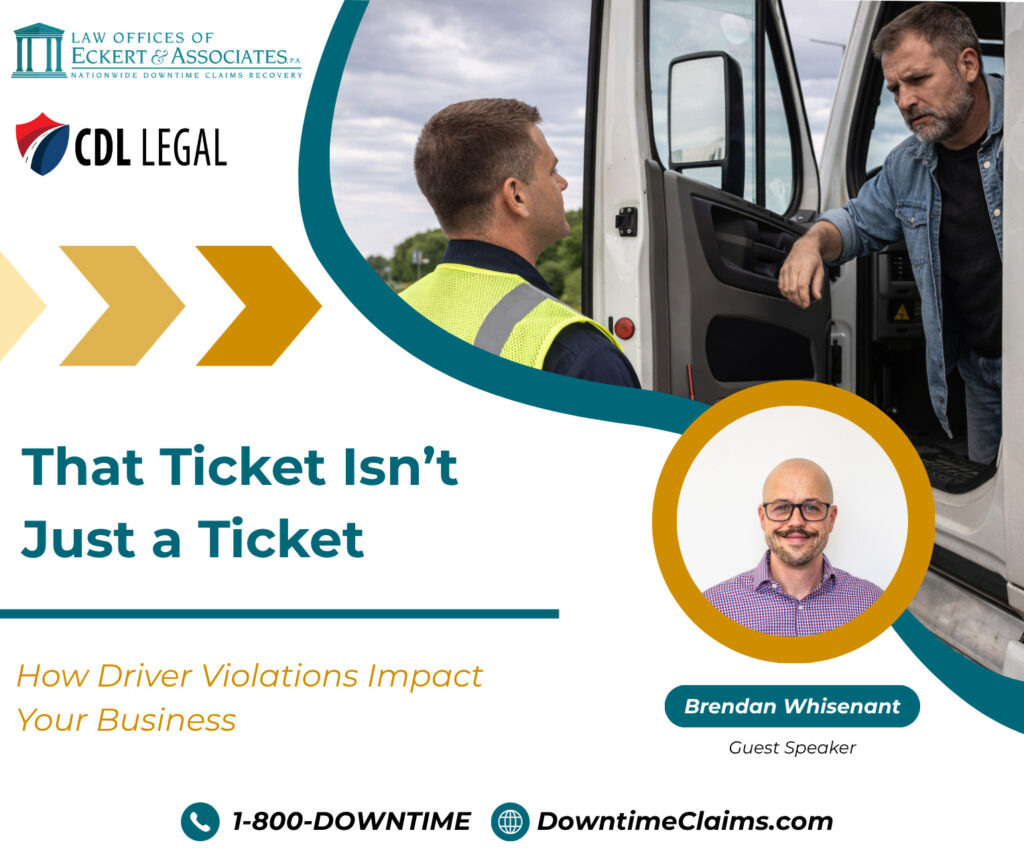
You run a tight operation. You know your drivers, your lanes, and your loads. But there’s one thing many owner-operators and small fleet managers overlook until it’s too late: a single unmanaged driver ticket—and its impact on trucking CSA violations—can quietly unravel everything you’ve built.
This isn’t a scare tactic. It’s the reality of how CSA scores, insurance, freight contracts, and DOT scrutiny are all connected. One small misstep, left unaddressed, can snowball into a business-level crisis.
The Moment a Ticket Becomes a Carrier Problem
When a driver gets cited on the road, the natural instinct for many small fleets is to let the driver handle it. They’ll pay the fine, plead guilty, and move on. Problem solved. Or so it seems.
In reality, that guilty plea doesn’t just close a case. It locks in CSA points on your carrier profile. Depending on the violation, those points can trigger a cascade of downstream consequences that hit your operations hard:
- More roadside inspections, which eat into drive time, idle fuel costs, and driver patience
- Loss of freight, because shippers and brokers use CSA scores to decide which carriers they’ll work with
- Insurance rate increases, or worse, loss of coverage entirely
- Elevated federal scrutiny that can trigger a full DOT audit
The window to fight a ticket is narrow. Once it’s closed, your options shrink dramatically. Waiting until an audit or insurance renewal to deal with violations is the most expensive mistake a small carrier can make.
“There is no part of your trucking business a ticket or citation does not impact.”
The Two Traps Most Small Carriers Fall Into
When it comes to driver behavior and violations, small fleet owners tend to fall into one of two traps. Both lead to the same bad outcome.
The first is doing nothing. “I can’t afford to lose a driver,” is a phrase heard far too often. The logic feels sound in the short term, but the real question is: can you afford to keep them? One driver’s unchecked behavior can put your entire business at risk, along with everyone who depends on it.
The second trap is swinging to the extreme: zero-tolerance policies so rigid they’re impossible to enforce fairly. Policies that can’t be lived by won’t be followed. They also expose you to inconsistency that looks just as bad to auditors as having no policy at all.
The answer lives in the middle: practical, enforceable policy with enough structure to create accountability, and enough flexibility to allow for coaching and correction.
What Enforcement Actually Wants to See
Here’s something that surprises many owner-operators: DOT auditors and insurance underwriters aren’t looking for perfection. They’re looking for progress.
A carrier that had a serious violation and responded with a documented corrective action plan is in a fundamentally better position than one with a pattern of minor violations and no response. Consistency of neglect signals to regulators that safety is not a priority, and that’s what triggers the most serious enforcement actions.
Auditors want to see that when something goes wrong, you found out why, fixed it, and created policy to prevent recurrence. That’s it. That’s the bar. Meeting it consistently is what separates carriers who recover quickly from those who spiral after enforcement action.
What Enforcement Actually Wants to See
Here’s something that surprises many owner-operators: DOT auditors and insurance underwriters aren’t looking for perfection. They’re looking for progress.
A carrier that had a serious violation and responded with a documented corrective action plan is in a fundamentally better position than one with a pattern of minor violations and no response. Consistency of neglect signals to regulators that safety is not a priority—and that’s what triggers the most serious enforcement actions.
Auditors want to see that when something goes wrong, you found out why, fixed it, and created policy to prevent recurrence. That’s it. That’s the bar. Meeting it consistently is what separates carriers who recover quickly from those who spiral after enforcement action.
Your Action Plan Starts Now
If you’re an owner-operator or managing a small fleet, here’s where to start today:
- Review your current CSA scores and identify any open violations
- Don’t let drivers handle tickets alone—have a process for responding to citations promptly
- Audit your safety policy. Is it enforceable? Does your team know it?
- Partner with a service like CDL Legal, which specializes in helping carriers respond to citations strategically, reduce trucking CSA violations, and protect operating authority
- Look at the last six months. Anything recurring needs a documented correction and a prevention plan
You don’t need a perfect safety record to run a competitive carrier business. You need a consistent, documented commitment to improvement. That’s what protects your operating authority, your insurance, your freight relationships, and ultimately, your livelihood.
“Do not wait until you are in an audit or renewals to care about safety and CSA. Be proactive.”
If you’re ready to stop reacting and start protecting your business, Brendan and the team at CDL Legal work directly with carriers and owner-operators to build smarter safety strategies and handle violations the right way.
Reach out to Brendan at bwhisenant@cdllegal.com to learn how CDL Legal can help keep your fleet moving and your scores where they need to be.

Brendan is a transportation industry expert with deep experience in carrier safety, CSA compliance, and driver risk management. He works with carriers and owner-operators to develop practical safety policies, navigate enforcement actions, and build the kind of safety culture that protects both drivers and the businesses that depend on them. To learn more, visit https://cdllegal.com.

